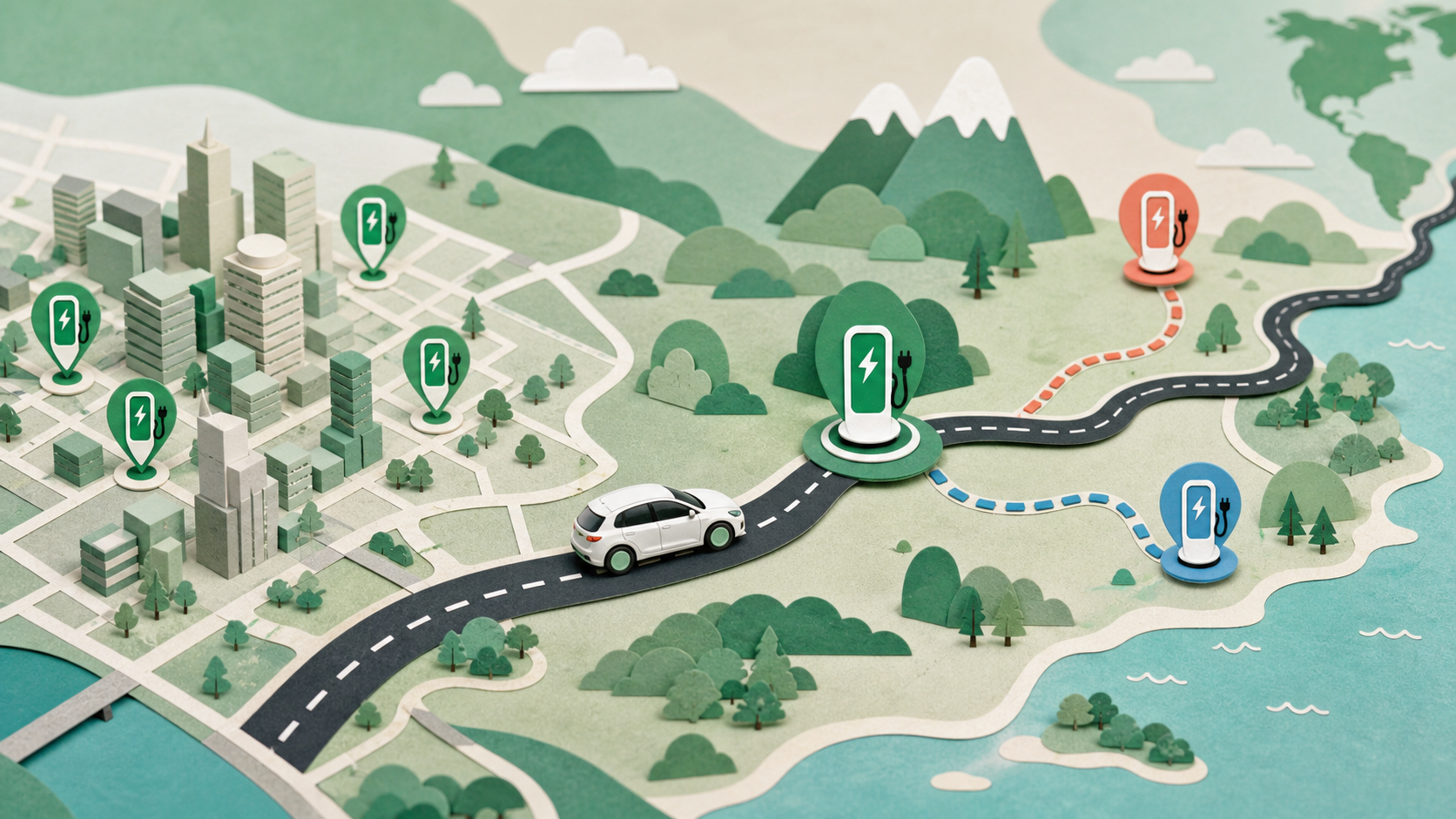
A hotel listing with an “EV charging” amenity is a starting point. Before relying on it, get the exact connector, guest-access rules, payment method and reservation policy from the hotel or charging operator. Then plan where you will charge if the hotel bay is occupied or unavailable.
This is a practical booking checklist, not a certification scheme or an inspection of individual hotels. It separates what a map can show from what the property needs to confirm for your stay.
1. Identify the charger you would actually use
Ask for the charging network, station ID and a photo of the connector or socket. Match those details to your vehicle and any adapter approved for that vehicle. A description such as “Tesla charger” or “fast charger” is too broad to establish access for your car.
The U.S. Department of Energy explains that charging time depends on battery capacity, charge level, the car's charging capability and the equipment. Its charging guide distinguishes J1772, CCS and J3400/NACS equipment in the United States. Connector standards differ by region; confirm the actual plug rather than assuming that a connector name in another country's guide applies to your trip. [1]
Also ask how many vehicles can charge simultaneously. A photo showing two cables does not establish two independent charging spaces. The Department of Energy distinguishes a station location, a charging port and its connectors: one port can have multiple connector types while charging only one vehicle at a time. [1]
2. Confirm access for your arrival and departure times
Send the property your expected arrival time and ask whether the charger is inside a locked car park, whether reception must activate it, and whether overnight use is allowed. Confirm whether a charging space can be reserved separately from the room. If it is first come, first served, plan on that basis.
Ask for all charges in writing: energy, charging time, session, parking and any fee for remaining connected after charging. Record the currency and whether a hotel guest receives a different tariff. “Free parking” does not answer whether electricity is included.
For a networked charger, confirm the correct app or card before travel. As one provider example, ChargePoint documents starting sessions through its app, an activated card or supported Tap to Charge functionality. That does not mean every hotel charger accepts those methods; use the instructions for the named operator and station. [2]
3. Check recent evidence and understand its limits
Use the PlugSphere charging map to find the location and inspect reported connectors, power and access. PlugSphere imports Open Charge Map station data. Open Charge Map draws information from multiple providers and community contributions, so a listing helps with discovery but is not a reservation or a live availability feed. [3]
Where supported, check the operator's current station page. ChargePoint's documentation, for example, describes port status, pricing and site-access details in its app. [4] A status seen today cannot guarantee that a bay will be free on a future travel date.
Compare dates as well as ratings. A recent detailed report about the exact charger is more useful for a specific question than an undated badge. If sources disagree, ask the hotel which station the report refers to and whether the problem has been resolved. Do not convert a website's general “verified” label into a numerical probability that your session will work.
4. Estimate whether the overnight stop is long enough
Use the charging-time calculator with your usable battery capacity, expected arrival charge and desired departure charge. Enter the car's AC limit as well as the charger's rated power. A larger number on the charger alone does not determine the result.
Here is an illustrative calculation, not a prediction for a named car or hotel:
| Input | Example assumption |
|---|---|
| Usable battery | 60 kWh |
| Arrival and target charge | 30% to 80% |
| Energy added to the battery | 60 × (0.80 − 0.30) = 30 kWh |
| Assumed charging efficiency | 90% |
| Estimated electricity drawn | 30 ÷ 0.90 = 33.3 kWh |
| Assumed constant charging power | 7 kW |
| Estimated charging time | 33.3 ÷ 7 = about 4.8 hours |
The 90% efficiency and constant 7 kW are chosen assumptions, not measurements. If the car and station together deliver only 3.5 kW, the same estimate becomes about 9.5 hours. Shared power, interruptions and vehicle behaviour can change the result. Use the example to decide what to ask the hotel and how much time to allow.
5. Save a usable backup before committing
Choose a second compatible charging location and check its access hours and payment method. Consider whether you could reach it with your expected arrival battery if the hotel charger added no energy. A nearby pin behind a locked gate is not a useful backup for a late arrival.
Use the EV route planner to estimate the journey with your chosen arrival reserve. Its results are planning estimates; verify the selected stop with its operator. If hotel charging is essential and the property cannot confirm the basics, arrange a charging stop before checking in or choose accommodation that answers those questions clearly.
A message you can send to the hotel
Copy and adapt this enquiry. You do not need to share payment details or a booking password:
I plan to arrive on [date] at [time] in a [vehicle model and connector]. Could you confirm the charging network or station ID, connector, power per vehicle and number of usable spaces? Can a charging space be reserved? Please confirm access at my arrival time, the app or card required, all charging and parking fees, and whether I may remain connected overnight. Has this specific charger been used successfully recently? If it is unavailable, which nearby alternative do you suggest?
Keep the response with your travel notes and recheck close to departure. A confirmation is useful evidence of the hotel's stated arrangements, not a guarantee against a later fault.
Turn the reply into a booking decision
| What you know | Next action |
|---|---|
| Exact compatible connector, clear access and payment, enough charging time | Save the details and a backup; recheck before departure. |
| Charger exists but spaces cannot be reserved | Treat charging as conditional and plan an alternative. |
| Only a generic amenity icon or an old photo | Ask for the exact station and current arrangements. |
| Conflicting reports or an unresolved fault | Avoid making your next driving leg depend on this charger. |
On arrival, follow the station instructions and check that the vehicle actually reports charging before leaving it. If the equipment is unavailable, contact the property or operator and use the backup plan. A room booking and an advertised charging amenity do not by themselves confirm a successful charging session.