Real-world battery range estimate
EV Range Calculator
Estimate how far an electric car can travel from its current battery percentage while protecting an arrival reserve. Enter recent real-world efficiency, then test a transparent allowance for cold, heat, speed, wind or load.
Use the free tool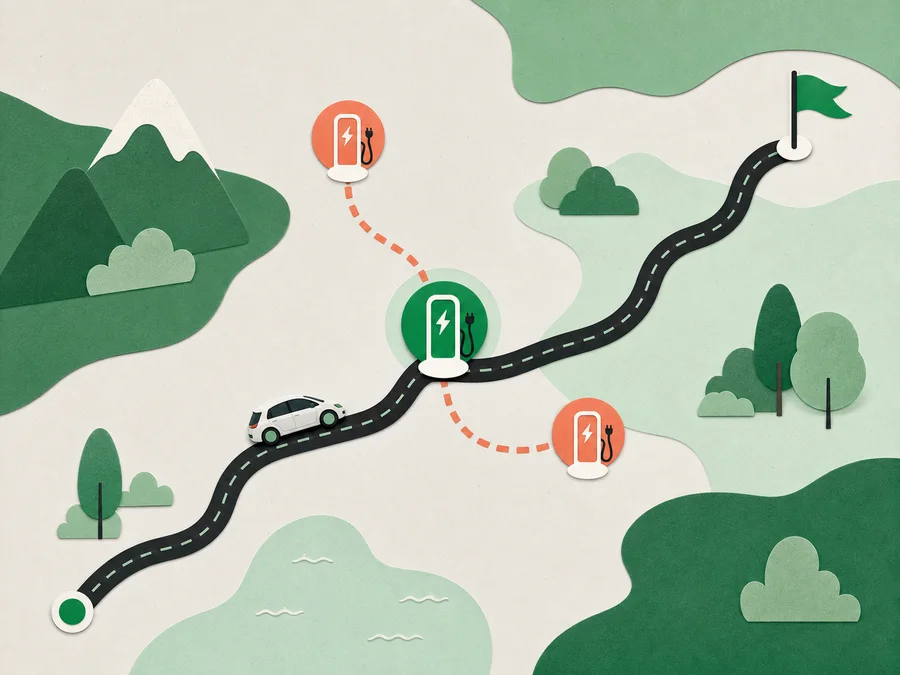
Turn the estimate into a journey
Need charging stops inside that range?
Use the same battery, consumption and reserve in the route planner to compare compatible primary and backup chargers.
How this EV range estimate is calculated
- 1 Available energy equals usable battery capacity multiplied by the difference between current charge and the arrival reserve.
- 2 The calculator converts the efficiency input to kWh per 100 km, then applies the condition adjustment to consumption—not directly to range.
- 3 Estimated range equals available battery energy divided by adjusted energy use. The same assumptions produce the full-battery and 80%-to-reserve comparisons.
- 4 This is not a vehicle-specific prediction. Recent trip-computer consumption is usually more useful than a laboratory rating for the journey conditions you expect.
EV Range Calculator FAQ
Source-backed answers to the questions drivers ask before using this estimate.
How do I calculate EV range from battery size and efficiency?
Multiply usable battery capacity by the battery percentage available above your chosen reserve. Divide that energy by consumption in kWh per distance. For example, the calculator converts every input to kWh per 100 km before returning both kilometres and miles.
Source: US Alternative Fuels Data Center
How far can my EV go from its current battery percentage?
The answer depends on usable battery capacity, current charge, the reserve you want to keep and expected energy use. Use recent trip-computer consumption when possible, because speed, temperature, climate control and driving style can move the result away from the official rating.
Source: US EPA electric-vehicle guidance
What is the difference between usable and gross battery capacity?
Gross capacity describes the complete battery pack, while usable capacity is the energy the vehicle makes available for normal driving. Use usable capacity here when it is published; gross capacity can make a simple range estimate too high.
Source: US EPA technical explanation
Can I calculate EV range with miles per kWh?
Yes. Select mi/kWh and enter the efficiency shown by your car. A larger mi/kWh value means the vehicle travels farther with each kWh. PlugSphere converts the value internally and shows the estimate in both miles and kilometres.
Why can real-world EV range differ from EPA or WLTP range?
Official range comes from controlled test procedures. Real journeys vary with high-speed or aggressive driving, hot or cold weather, heating and air conditioning, terrain, wind, tyres, payload and vehicle configuration. Treat this result as a transparent scenario, not a replacement rating.
Sources: US EPA fuel economy and EV range testing · EU WLTP regulation
How should I estimate EV range in cold weather?
Use recent winter consumption from the same vehicle if available. Otherwise, increase the consumption adjustment and compare several scenarios. Cold battery operation and cabin heating can reduce range, while the result varies by temperature, trip length, speed and heat-pump performance.
Does highway speed reduce electric-car range?
It can. Higher speed and aggressive acceleration are among the factors the EPA accounts for when adjusting laboratory results toward a real-world label estimate. For planning, use consumption measured on a similar high-speed trip or add a clearly visible consumption allowance.
Is this range calculator accurate enough to plan charging stops?
Use it for a quick scenario, not as a guarantee. For a journey, open the EV route planner, enter a conservative consumption value and reserve, then verify compatible charging stops and current station status before departure.
Related EV tools
Worldwide cost estimate
EV Charging Cost Calculator
Calculate EV charging cost in any currency from your start and target battery percentage. Include losses, tax, session, parking and idle fees.
AC and DC charging estimate
EV Charging Time Calculator
Calculate EV charging time from your current to target battery level. Compare 7–350 kW chargers using vehicle limits, charging losses and DC taper.
Worldwide route-energy planner
EV route planner with charging stops and backups
Build an estimated road route, calculate arrival battery and compare compatible primary and backup EV chargers ranked along the full route geometry.